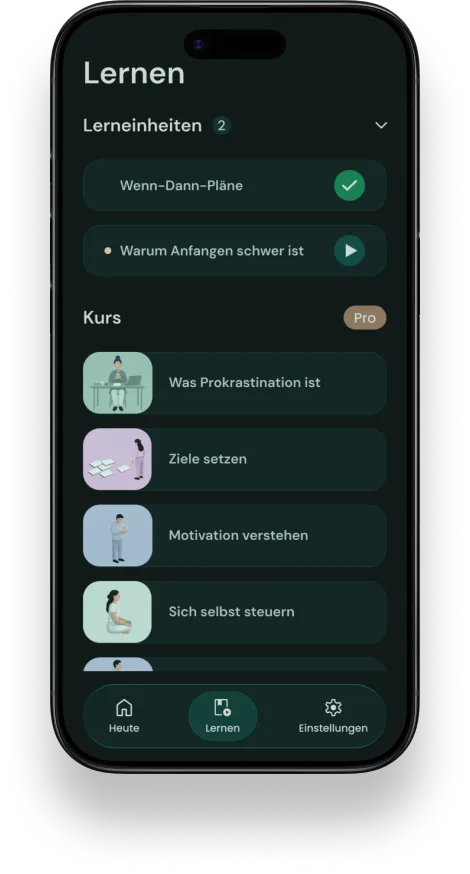
Step Zero
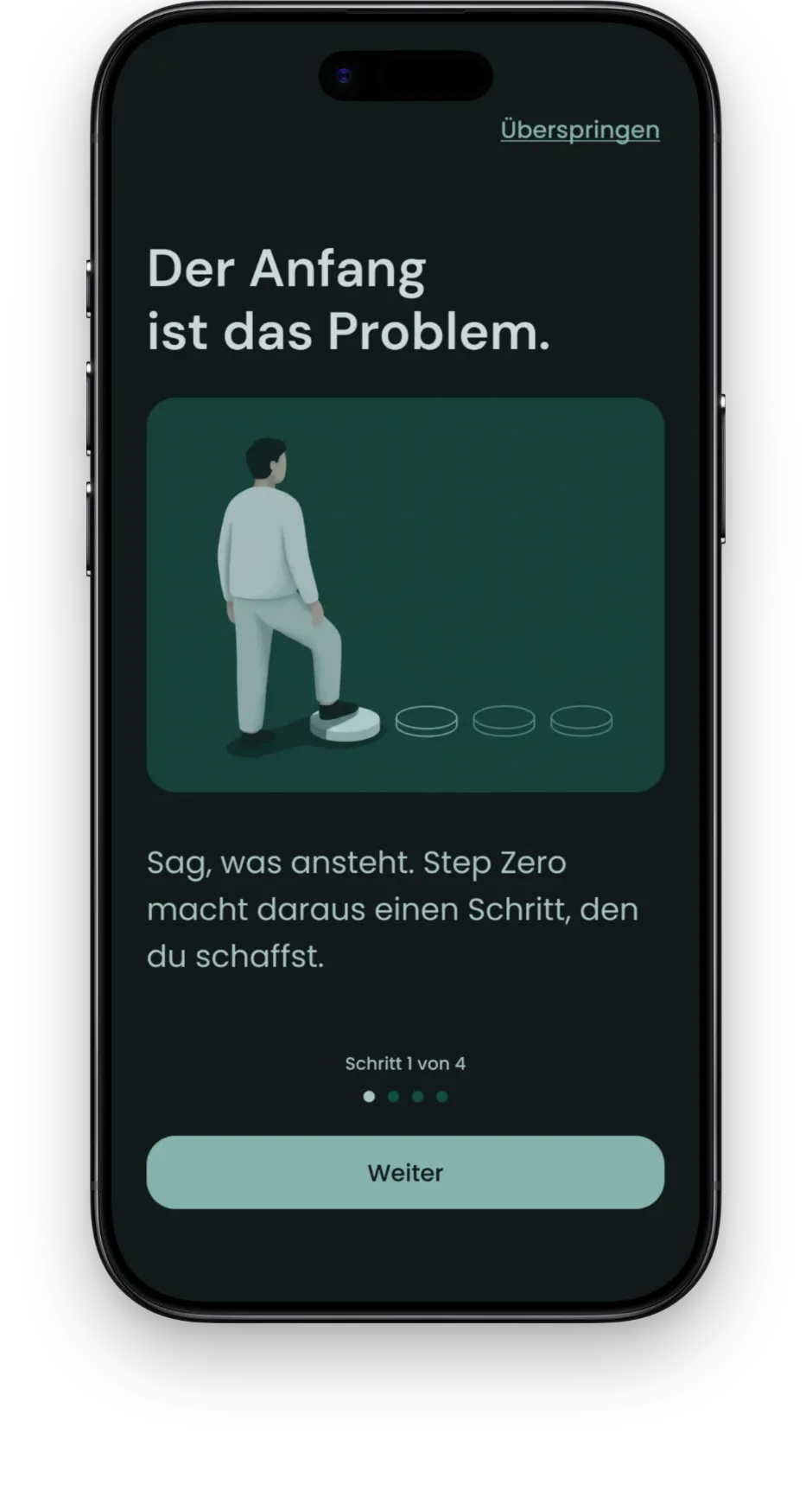
The first step for tasks when you don’t know where to start.
75 % of participants in my survey put off tasks because they don’t know where to begin. This app tackles exactly that.
Step Zero delivers that first step in the moment of blockage, and gradually hands the breaking-down back to the user.
01 / The problem
People aren’t lazy. They’re missing the first step.
Depending on the study, 7-14% of the population procrastinate so severely that treatment would make sense. In my survey, the most common trigger wasn’t a lack of time or motivation, it was an unclear starting point.
The interviews revealed a second pattern: people escape into “productive” substitute activities, cleaning, emails, job applications, while the postponed task keeps coming back to mind. Most affected: students and knowledge workers facing large, unstructured tasks with distant deadlines.
75%
name “the start is unclear” as the trigger for putting tasks off.
Online survey, n = 20
3-6x
a day, most respondents think about the task they’re avoiding.
Online survey and interviews
I simply didn’t know where to start.
Online survey and interviews
02 / Process & key decisions
Four moments where the data changed my direction.
From “unpleasant” to “unclear”
My starting hypothesis: people postpone tasks because they feel unpleasant. Interviews and the survey pointed somewhere more specific, 9 of 12 named an unclear start, just as many a task that felt too big. An emotional problem became a structural one. And structure can be designed.
Cluster: Unclear start & task size
Affinity map“I simply didn’t know where to start.”
15 of 20: “the start is unclear”
“It was mainly the size of the task, not knowing how to begin.”
Research: poorly structured tasks invite procrastination
Dropping social accountability
After the interviews, everything pointed to accountability: the library, a video-call buddy, body doubling. The survey disagreed. So instead of a social feature, I put the start itself at the centre.
Interviews suggested
Social accountabilityOnly 5 of 20 rated working in public places 4 of 5. Eight gave it 1 point.
Survey showed
Preparing the environment
Scored several 4s and 5s, the strongest strategy in the data.
Designing for “The Blocked”
Two segments stood out: The Blocked, who fail at the start, and The Pressure-Dependent, who only move once panic sets in. I chose The Blocked, their trigger was named most often, and it can be solved structurally.
Primary persona

Alexander, 24
Master’s student, writing his thesis
Problem statement
Alexander needs a way to translate large tasks into a tangible first step, because without that clarity he falls into avoidance instead of action.
An app that makes itself unnecessary
Any to-do app or ChatGPT can break down a task today. What’s hard to copy is the gradual withdrawal of help: over four stages, breaking tasks down moves from the app to the user.
Idea A
CBT course
Five modules over five weeks.
Idea B
Preventive breakdown
Splits every task when it’s created.
Chosen
Fading start aid
One step in the moment of blockage, then hands the skill back.
My riskiest assumption
A small enough first step is enough to break the blockage.
The risk
If perfectionism or fear of judgement is really behind it, Alexander won’t touch even the perfect list of steps.
How I tested it03 / The solution
One screen, one step.
Step Zero isn’t another to-do app. It doesn’t help you organise. It helps you start. Every screen does one thing, and the size of the task stays invisible until you’re already moving.
Step 1 of 5
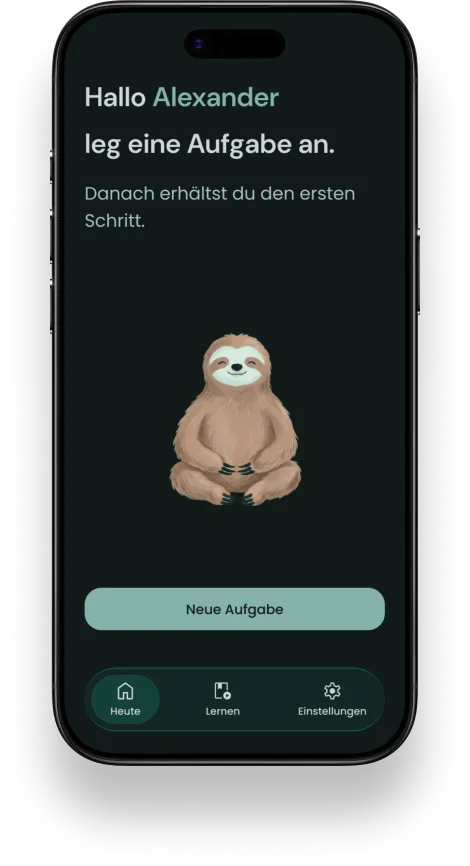
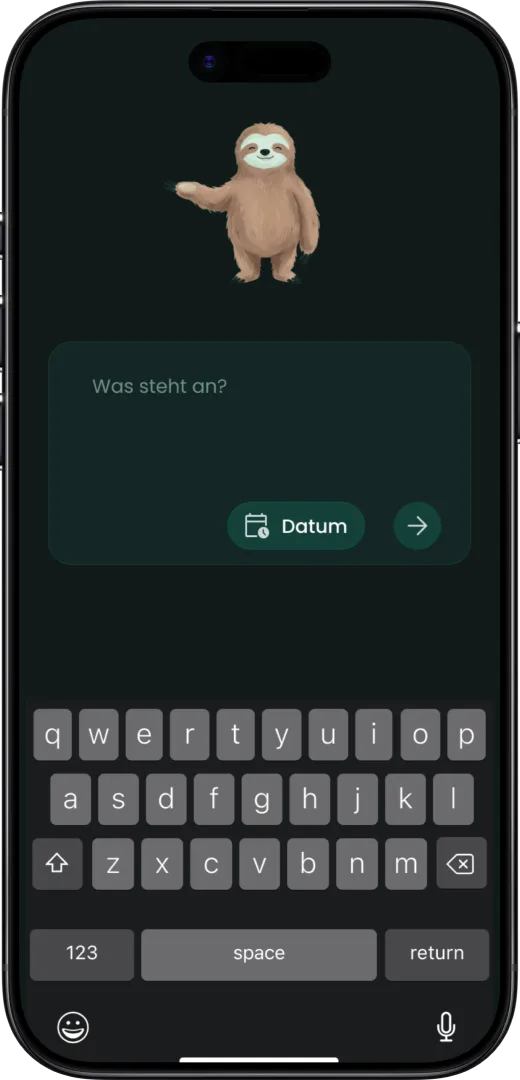
Enter a task
Type the task as vaguely as it sits in your head.
No form, no required fields. The placeholder asks a question instead of showing an example, frustration tolerance is lowest in the moment of blockage.
Step 2 of 5
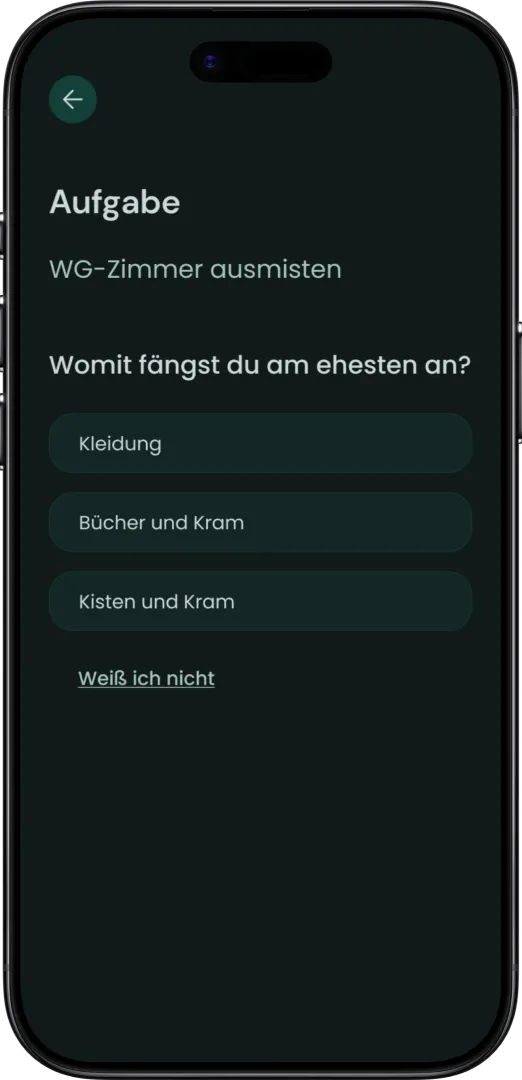
Clarifying question
Answer two short questions with a tap.
A generic first step destroys trust instantly. “I don’t know” is always an option, so the question never becomes the next hurdle.
Step 3 of 5
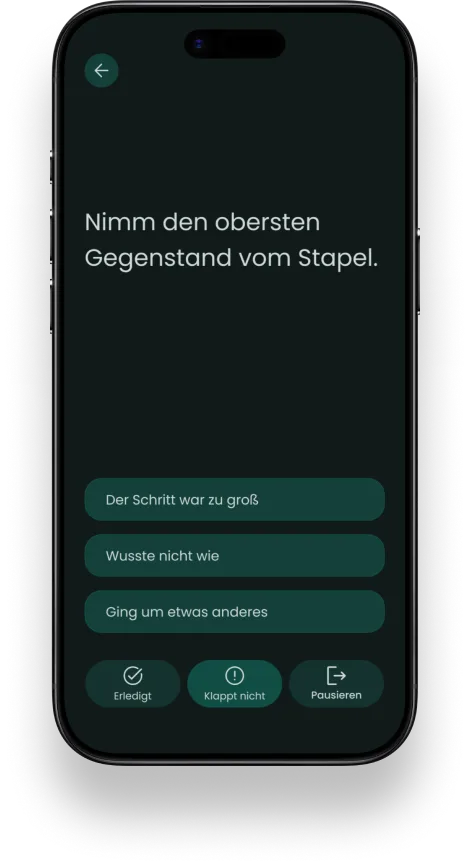
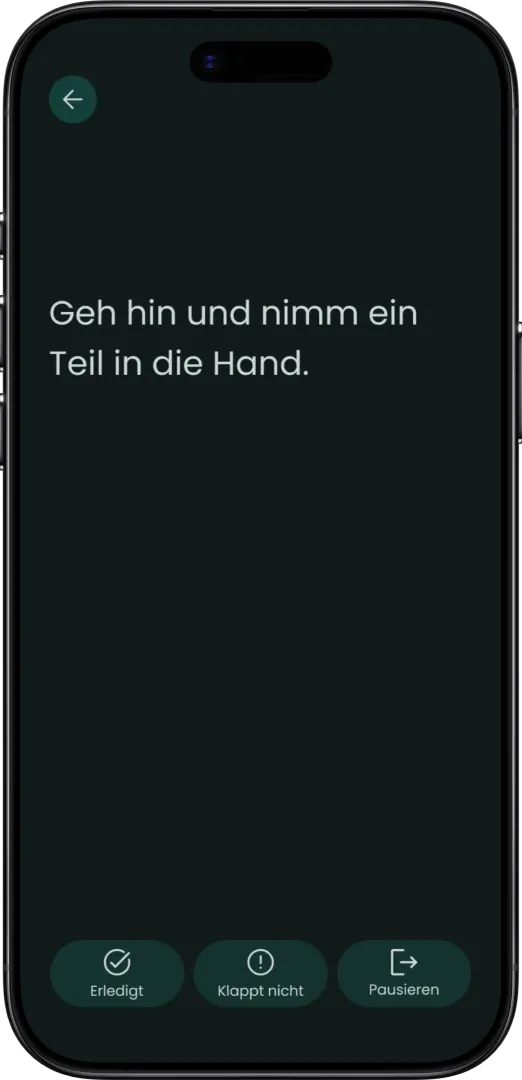
Step view
See exactly one step, and start it.
No progress bar, no remaining count. The size of the task stays invisible, and the accent colour is reserved for the one action.
Step 4 of 5
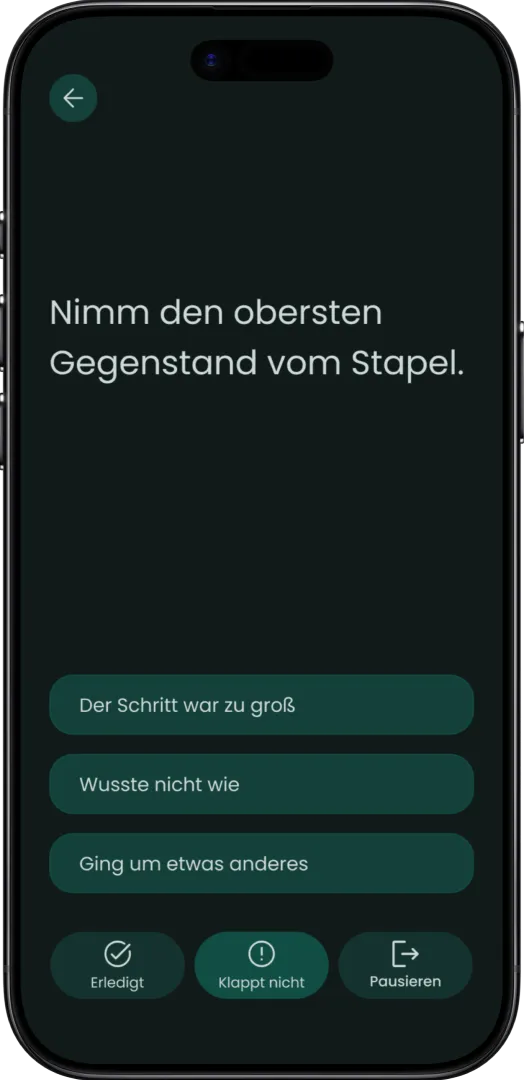
“Didn’t work”
Say why a step didn’t work, and get a smaller one.
Stopping isn’t failure, it’s information. The system calibrates the size of each step per person.
Step 5 of 5
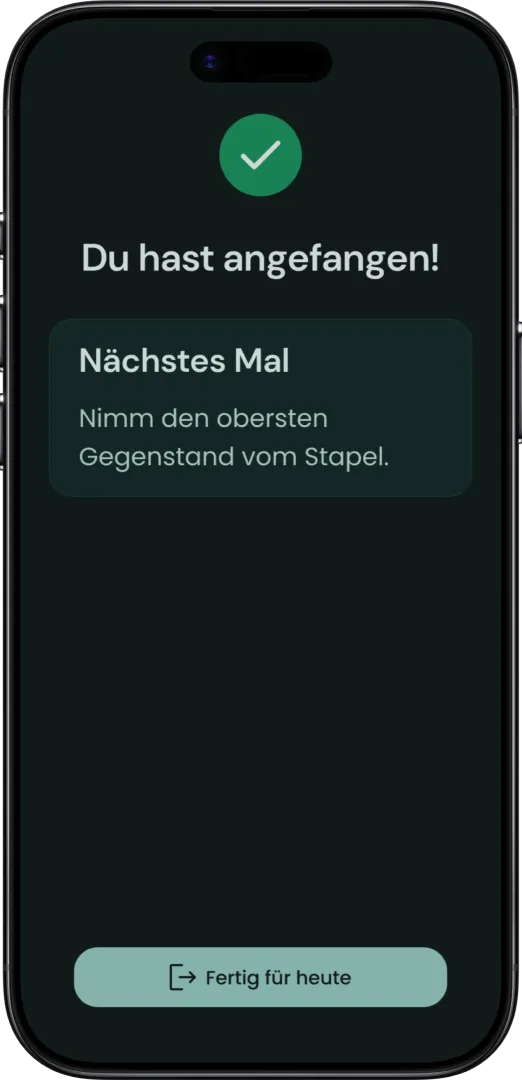
Done for today
End the session, without guilt.
Shame keeps procrastination going. No streak that resets, no wording that assigns blame, just a 90-second learning unit on what just happened.
By clicking, the video loads from YouTube and data is sent to Google. Privacy policy
Prototype
See it in motion
A walkthrough of the clickable prototype, from the first screen to the first completed step.
- One screen, one step
- No progress bar, no remaining count
- Stopping is information, not failure
04 / Testing & iteration
Did the first step hold up?
I tested the mid-fi prototype with 1 person from the target group, in person, using think-aloud. The scenario: decluttering a room full of moving boxes, a typical task with no clear starting point.
What I measured
On the step view, does the participant state a concrete intention to act, “Then I’d open the first box”?
That is the test of my riskiest assumption.
What the test showed, and what I changed
| Observation | What I Changed | Priority |
|---|---|---|
| During onboarding, the tester tries to swipe intuitively, but this isn’t possible in this Figma prototype | Integrate the swipe feature (on drag) into the onboarding process | Critical |
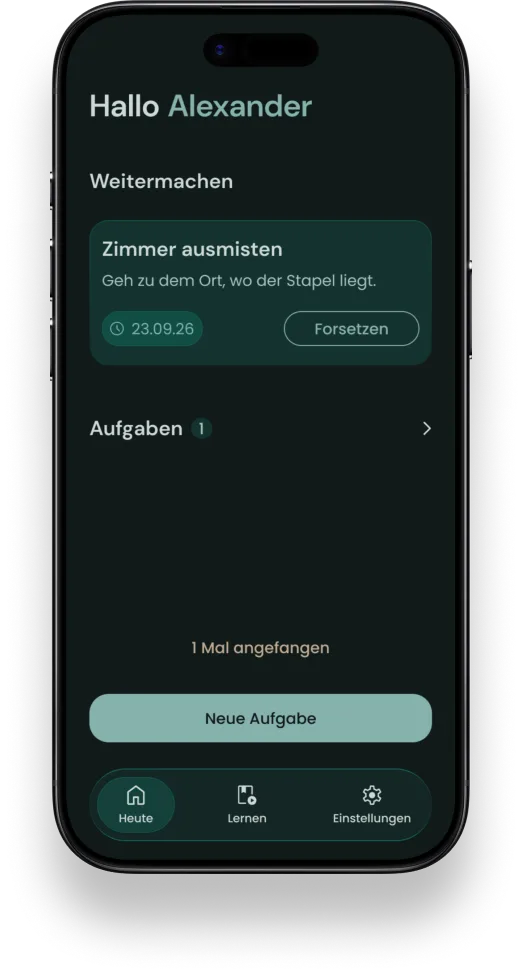
| The tester does not recognize the purpose of the card for returning to the task. | Communicate the purpose of the map more clearly by adding a section heading titled “Continue.” | Critical |
| The placement of the step counter (x tasks started) directly below the heading is noted. | The step counter is placed above the “New Task” CTA button. Here, it is not associated with the H1 heading and is easier to understand in terms of content. | Important |
05 / AI in the design process
Where AI sped things up, and where I decided.
Claude
Ideation
What it did
I used it to add to my list of potential solutions and then select the top 3 ideas from among them that best suited the target audience.
My call
Picking the top 3 and justifying the choice with research data.
Claude
Synthesis
What it did
I used Claude to generate initial cluster suggestions based on the interview notes, survey results, and research find.
My call
Generate clusters based on the interview notes, survey results, and research find
06 / Learnings & outlook
What I’d do differently
Interviews show why, not how often.
After three interviews I was sure social accountability was the key. The survey proved me wrong. I no longer build a decision on a pattern I haven’t cross-checked.
Mark evidence gaps instead
The motivation field of my persona was barely backed by data. I labelled it as an assumption instead of making it sound plausible.